

How To Draw Multiple Straight Line In Oil Painting
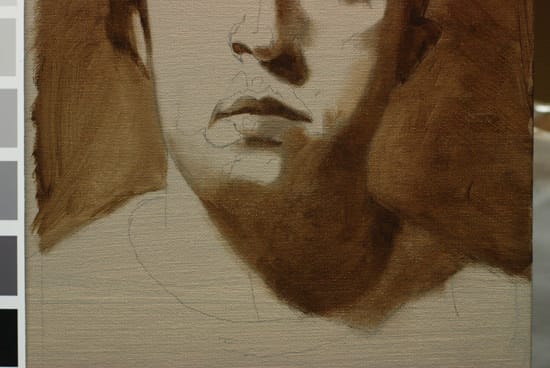
How to paint a black & white portrait in Oils
Have yous been practising your portrait drawing for years still making the jump to oil portrait painting ever seems to terminate in an underwhelming finish?
Or do you walk effectually portrait galleries in awe with the question, 'How do they do that?'
Mayhap you're frustrated past your process and don't know how to modify it.
Portraits can seem like the toughest bailiwick to cleft and yous tin can hands exist disheartened by your efforts. 1 wrong brushstroke can crusade a subject to all of a sudden look 'incorrect', panic sets in – your pencils become sharpened, charcoal out and y'all don't come up back to painting for a while.
But you don't desire to draw anymore, you want to pigment.
So where do y'all brainstorm?
A Stride-by-Stride arroyo
Materials
Why oil portraits?
They dry slowly, and for portraits time is essential.
Let us offset at the showtime.
I'one thousand going to keep things simple.
- 3 easy techniques to learn.
- iii bones paints to employ.
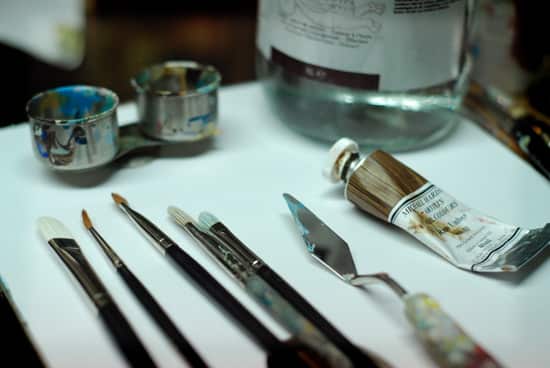
Oil paint – for this series of demonstrations I volition exist using Artist quality oil paints.
- Raw umber
- Ivory black
- Flake white (or Titanium White)
Oil paints are fabricated by mixing ground pigment (the colour) with a drying oil. Most artist quality paints are mixed with common cold pressed linseed oil. Whites often are mixed with a different oil, walnut or poppy oil, as they are less yellowing than the linseed oil.
I'm using Artist quality paints which have a college pigment quality than pupil grade paints, you can read about the differences (see the 8 key differences between creative person & educatee grade paint)
I am using a mixture of brands including Michael Harding, Old Holland & Winsor and Newton.
Support – ( what you paint onto)
A 5 or 6mm thick piece of MDF tin can be a neat starting signal. Ready the surface with an acrylic gesso, sanding in-between coats, run across here how to utilize gesso.
Pro tip: Make certain to give all sides of the MDF board a coat of size, specially the edges which tin can be very absorbent to moisture.
Many portrait artists prefer to work on linen rather than cotton as you can get a finer weave but for this demonstration, I am using a pre-primed canvas. The bodily canvass is a Belle Arti Cotton Sail.
Brushes – For this demonstration I'll be using:
- Rosemary & co Ivory Filbert– size iv, two & 10 (size 6 & viii are too very handy to take)
- Rosemary & co Kolinsky Sable series 33 Round – size iii
- Rosemary & co Kolinsky Sable serial 66 Filbert – size viii
To acquire more about brushes encounter a quick way to understand brushes
Coloured ground
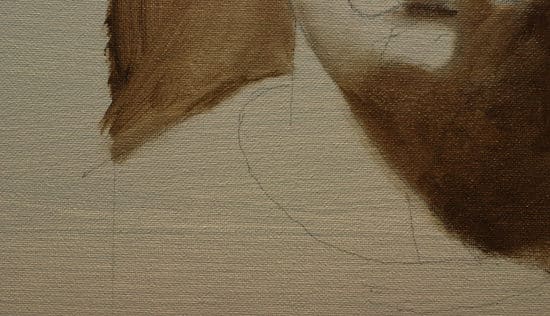
Oil paints increase in transparency with historic period, even thick opaque colours. To test for yourself, brand a few pencil or pen marks on a piece of flake canvas or board, pigment over them opaquely and so take a photograph to come across the coverage, check back the next twenty-four hour period and and then the adjacent week to run into if the opacity has changed.
For a tonal study, a coloured ground is a must, it helps you to constitute the extremes of the painting, the darkest darks, and the lightest lights. It too makes it easier for you to judge tones and is a lot more forgiving than a white canvas.
Pro tip: you can, of form, experiment with a pure white footing for creating an underlying glow to the skin. The Pre-Raphalite painters were fond of this method. Traditionally, the white basis has been used to illuminate the transparent layers of oil colour.
Acrylic or oil for the ground?
I have used acrylics in this case. It is a mixture of raw umber and titanium white, notice how it has been applied quite thinly, with some of the white gesso showing through. This is for 2 reasons:
- I don't desire to lose the 'tooth' of the canvas. The tooth is the grain, and texture of the canvas and helps to pull the pigment off the castor. If yous pigment on a smooth prepared board you will notice the difference with the paint feeling like it is 'sitting on top' on the surface.
- You don't want to create a seal with thick acrylic, you lot still need the oil to be able to attach to the surface underneath, so always add together h2o to your acrylic mixture.
You lot could besides use quick drying oil paints which are sometimes called Alkyds.
Or found a tone just with raw umber and turpentine (or odourless mineral spirits) or standard raw umber and quick drying white.
White pigments dry more than slowly than the raw umber which is an earth colour and dries adequately apace (which is why I recommend a quick drying white above).
If you have an underpainting that has too much oil in it, you will be breaking the number one rule of oil painting – fat over lean
What is fat over lean?
A new Paleo nutrition plan?
No, fat over lean is the expression painters utilize to brand sure yous prevent your oil painting from peachy.
Information technology basically means that each succeeding layer of paint should have more than 'fat – oil' than the preceding layer.
It's all to practice with how oil paints dry.
- Turpentine or odourless mineral spirit (OMS) dries past evaporation.
- Oil dries by oxidation – it absorbs oxygen
For this first stage, we volition be using OMS or Turpentine mixed with the oil paint so it has a 'lean' underpainting which volition dry out apace.
When nosotros get the next stages of the portrait painting we volition be mixing linseed oil with our oil pigment and these layers will be more than oil-rich, hence 'fatter' and will take longer to dry.
Palette layout and tone
For this get-go 'blocking in' of the painting, we will be painting with raw umber only.
For farther paintings and for a darker finish, a mix between raw umber and ivory black will exist used, however, a slap-up deal can be learned by just using raw umber and white.
The pick of palette colour can be a deciding factor in your success.
The paradigm beneath shows the different optical effects that happen to the colours depending on the color or tone of the palette they are placed on. If you lot were working on a very dark painting – a black palette would be very useful as beginners have the trend to never go night enough when they first start painting.
And when yous see the raw umber on the white palette yous tin can shortly run across why – the raw umber looks black.
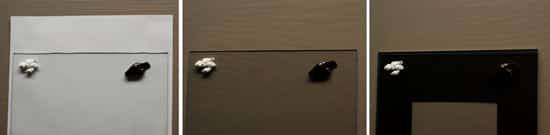
For this painting tutorial, I will exist using the mid-tone pick. A canvass of perspex (3mm thick) that I have just laid on top of the coloured basis canvas (raw umber & white).
Please annotation: Even though there is white on my palette this is merely to illustrate the differences in using a tonal palette. I don't apply white at all in the first section of the painting.
Pro tip: When painting in the studio I take a larger sheet of drinking glass that I tin can adjust the tones underneath depending on the subject affair. The tones could be a sheet of grey paper, a slice of black card or a department of sail painted to a mid tone.
Reference photo
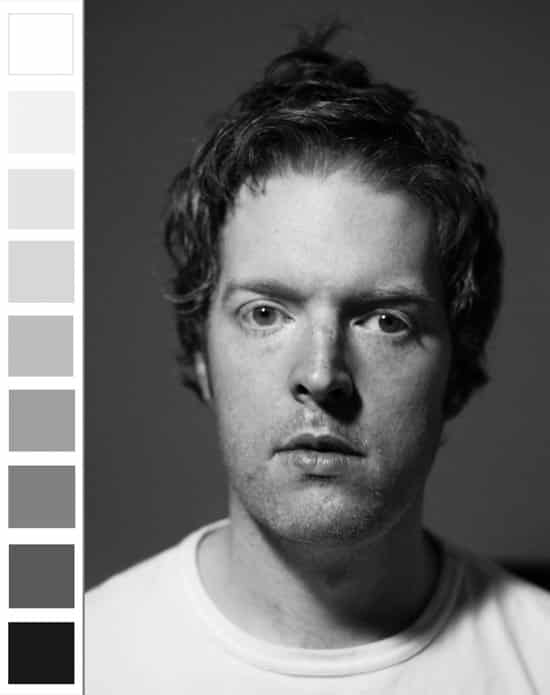
I have called a self-portrait, as when you're offset starting y'all're more forgiving of any mistakes on yourself.
The fundamental points to notice are:
- a wide tonal range from the brilliant white of the t-shirt to the nighttime black of the pilus.
- a single light source and so you get a strong bandage shadow this tin assist to create the illusion of depth and interest in your painting.
- a dark background so the lights on the confront will stand up out
Drawing out portraits
Accurately representing the homo face up has been an obsession with artists for years and there is still something amazingly compelling nigh portraiture.
For this serial, I will be concentrating more on the technical approach using Classical Painting techniques rather than using this equally a serial on a Portrait Cartoon form.
Usually, the initial bug stem from a lack of knowledge of drawing.
If you have studied drawing, or are aware of the powerful tricks your brain can play with you when trying to record something accurately and then you lot are at an advantage for the initial cartoon out stage – however, if are more interested in learning the painting techniques then only accept your fourth dimension and sketch as accurately as you tin.

I've fatigued out the basics of the portrait painting onto the canvas with a 2B pencil and observe how I as well describe in the shadow line.
The shadow line is where no straight light hits the subject area, so the darkest darks. Information technology should be a unproblematic line drawing.
I gently rubbed over the initial pencil marks with a putty eraser only to leave the faintest of lines. The less graphite you have to mix into the paint the amend. Some artists adopt to draw in charcoal, or if you are working on a very photorealist finish a permanent mark with a fine tip tin can be used. Try to notice a brown pen rather than blackness, equally it is more forgiving.
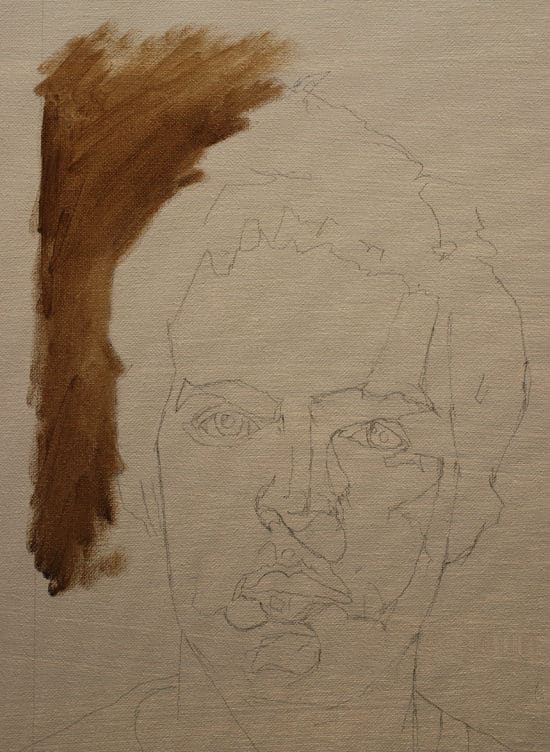
The commencement mix is raw umber diluted with the odourless mineral spirits – OMS. Pure gum turpentine is traditionally used and 'cuts' through the oil easier, merely if yous are working in a confined infinite with poor ventilation and so odourless mineral spirits are a great selection. 'Zest-it' is too dainty to apply and has a citrus scent.
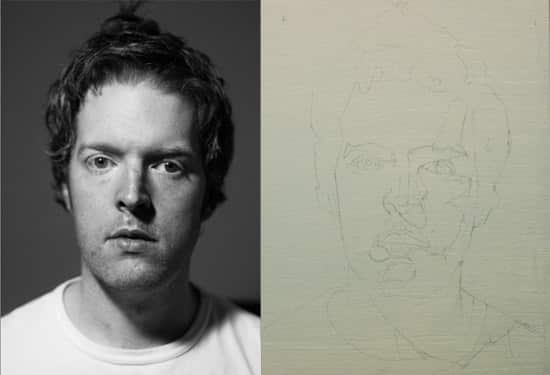
For this example, the reference photograph is the same size as the painted epitome.
This arroyo and technique is associated with the sight-size method and tin be very effective when you are showtime starting portraiture.
You don't have to set upwards a cast or model from life, just print out your reference image the same size equally your canvas and practice working i: 1. This way you can quickly and easily estimate the tones and shapes in your painting, by flicking your eyes between the two images.
Step 1 – Block in the background

Working betwixt a number 2 and number four (Filbert Ivory brush) I begin to block in the background. The paint mixture is thin, however opaque. I dip my brush into the OMS, when I say dip, I mean ii mm. But a really tiny amount. I and then squeeze the brush tip in some kitchen roll and then the brush is damp but not wet.
I apply the paint with a scrubbing motion, working betwixt the smaller brush for the details, then swapping to the larger brush for the larger areas.
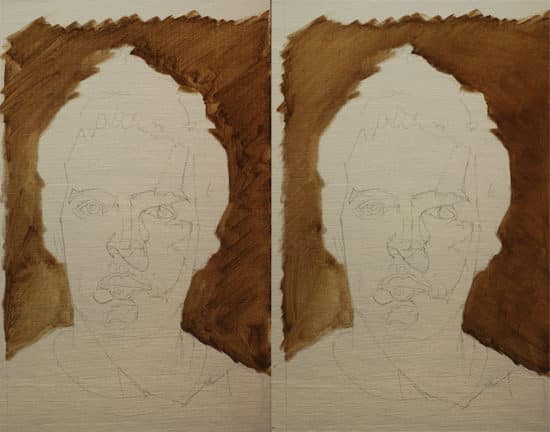
The initial 'scrub in' is quite loose, just to get a feel for the tone on the sheet. I and so work over it with a larger brush to polish out the tone. Nosotros are trying to proceed the tones apartment and simple then I work over whatever thicker areas of paint so the surface is more like a stain, rather than thick paint.
Step 2 – Cake in the darkest darks
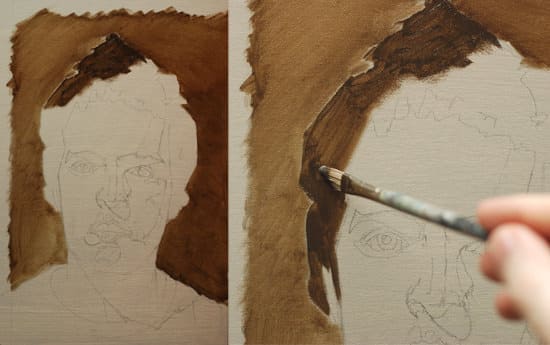
I now plant the darkest surface area in the painting, nonetheless just using the raw umber. Equally I know some of these areas are even darker than the raw umber I can experience the confidence to work with slightly thick pigment. Over again, not using also much of the OMS, it should feel like a dry brush effect and the more you 'scrub' the further the paint will go.
Areas, where the tones are very shut, are kept every bit i single mass tone. The tendency will be to desire to become in and add all the little subtleties and details you lot are beginning to come across.
Like chocolate on a diet, we take to learn to resist!
Step iii – Dry out brush in the shadow line
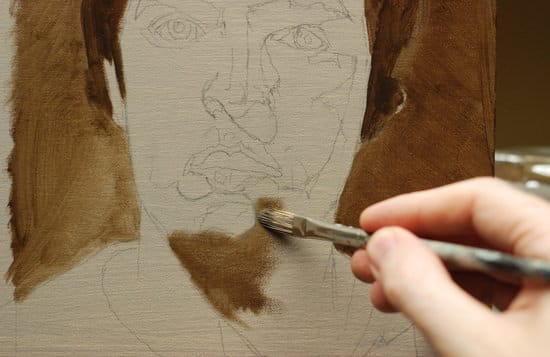
Notice how when I am applying the paint to the inner parts of the portrait I'chiliad keeping the edges very soft. This is key when building upward a portrait with this method. Hard, sharp edges are tough to cover over when y'all are working with thin layers of oil pigment so try and keep your edges soft in these early stages.
The tendency now will be to effort and catch some white and 'become painting' but once again this is unwise- retrieve- start slow, so you can finish chop-chop.
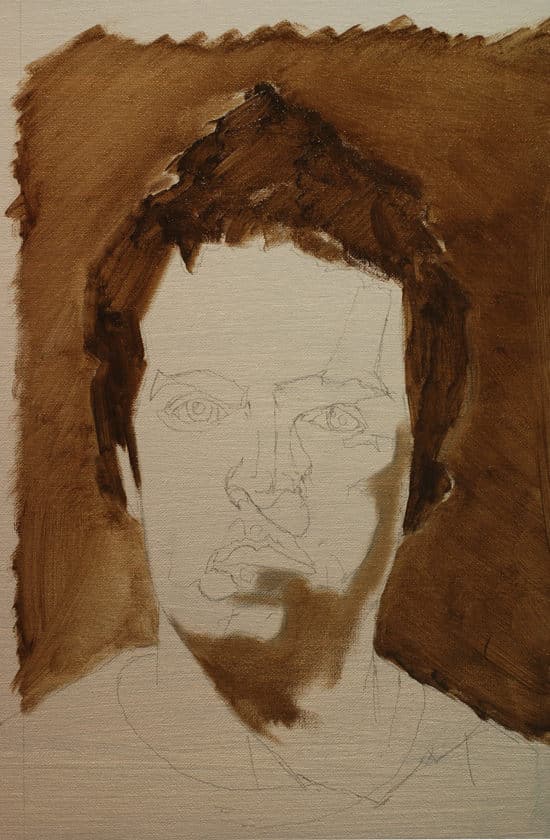
Check the drawing on your painting and check your tones are going along the correct lines. Y'all can squint your optics at the subject which is a very constructive method of simplifying tonal values.
Now have a await at the edges betwixt the background and the edge of the caput, notice how the hair and the ear are blurred. The photograph every bit been taken to mimic how the human being heart sees, then soften the edges.
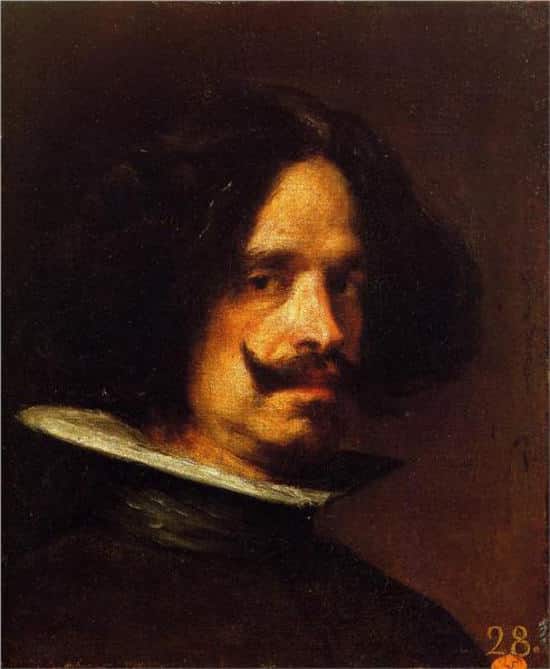
If nosotros look at Velasquez's self-portrait discover how soft and blurred the edge of the hair next to the face is. They blend into each other so your gaze is focused on his gaze.
Pace 4 – Soften the edges
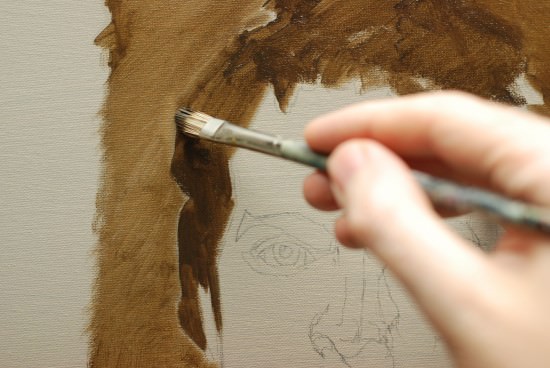
To blend an edge take a dry out brush (or a brush with a very little OMS if the paint is beginning to dry and yous still need to blend it) and gently brush over the line. I often utilise sables for this, every bit the softer hairs enable a smoother blend. The Ivory filberts are slightly softer than a pure sus scrofa brush so are still very useful when blending, you merely need to use a lighter touch.
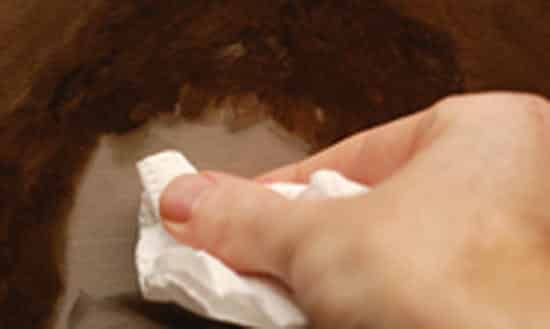
I sometimes also utilise a piece of kitchen scroll (ideally lint gratuitous) or a cotton rag to take the edge off. And sometimes only a finger will practice just to go that subtle alloy (If you lot similar the effect of using your finger for blending and then make sure you apply bulwark cream before you lot start your painting session. Be aware to wash your easily. I know I audio like your mum, but the lead used in some of the paints can exist dangerous if persistently having pare contact.
Footstep 5 – Add more than shadow detail
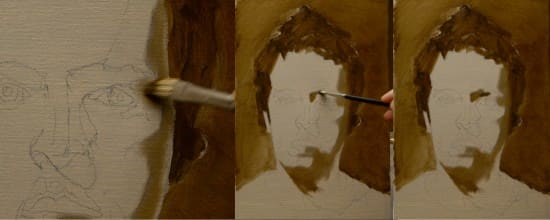
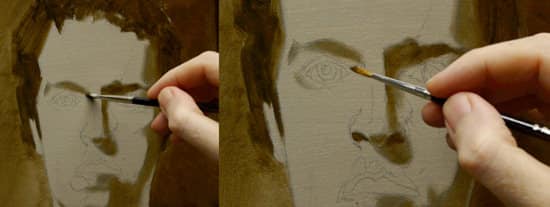
I now put some more than of the shadows into the portrait using the smaller circular sable, at this stage, I'm concentrating on the areas that would receive no direct light.
Information technology is important to identify what falls into dark shadows and mid tones and it is not as easy as it sounds. Really study your reference prototype and say to yourself:
'If I could only paint in pure black and pure white, what would I cull ?'
Everything that falls into the black category is what we are concerned with at this stage.
And so even though some areas on my cheek are nighttime, I don't put those in even so considering they are halftones and will come as the portrait progresses.
Y'all want to endeavour and keep your darkest shadows one dark tone so when you come to put in the halftones you will have more telescopic to model the form.
I'm even so keeping a apartment tone and a dry out castor so the effect is very soft.
Footstep six – Using a smaller brush
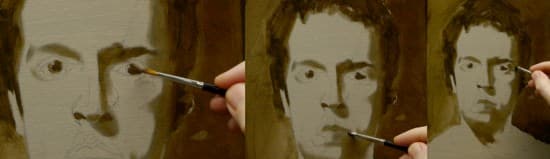
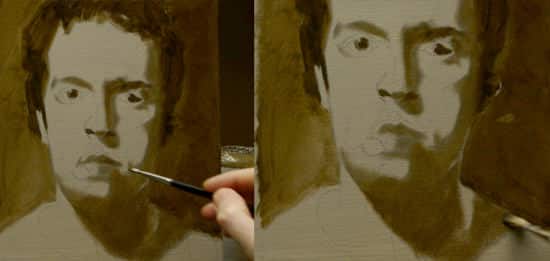
More detail, checking the cartoon and adding night to the optics, lips and collar bone.
Pace 7 – Refining shadows
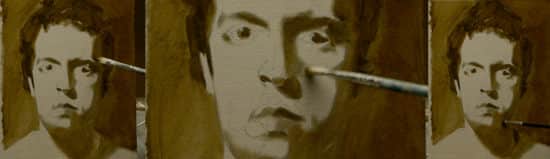
I now step back from the painting and squint my eyes, I flick my eyes betwixt the reference photo and the painting and adapt whatever difficult edges and cartoon.
Footstep viii – Checking edges and having a cup of tea


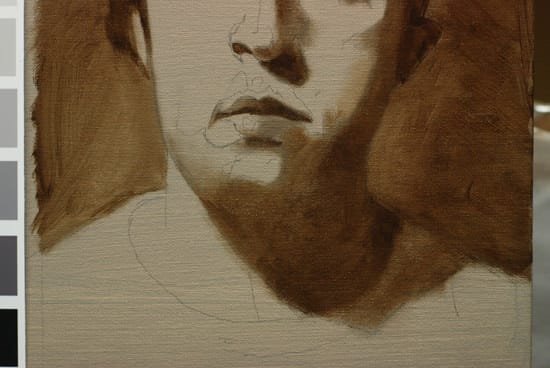
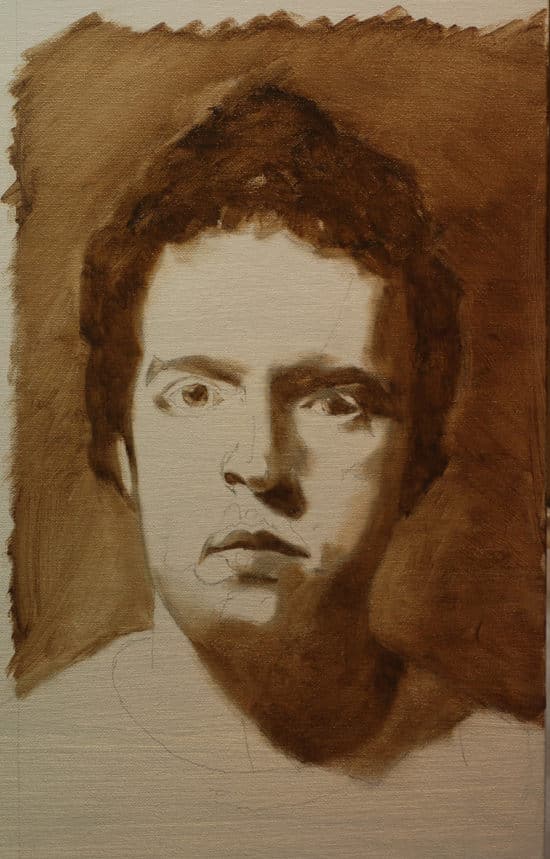
It is really of import when painting oil portraits to give your eyes a break, go and have a cup of tea, come back and make your concluding tweaks and get out this stage to dry overnight.
Brilliant, our showtime phase is done.
Happy painting!
You might likewise like:
1. How to Paint a Portrait in Oil – Role ii

Source: https://willkempartschool.com/how-to-paint-a-portrait-in-oil/
Posted by: stopsalave1946.blogspot.com
0 Response to "How To Draw Multiple Straight Line In Oil Painting"
Post a Comment