

What Conclusion Can You Draw About The Effects Of Civil Rights Legislation?
Civil law is a torso of rules that defines and protects the private rights of citizens, offers legal remedies that may exist sought in a dispute, and covers areas of law such as contracts, torts, belongings and family law. Ceremonious constabulary is derived from the laws of ancient Rome which used doctrines to develop a code that determined how legal issues would be decided. To explore this concept, consider the following civil police force definition.
Definition of Ceremonious Law
- Noun. The body of laws that govern ordinary private matters, split from laws presiding over criminal, military, or political matters.
- Noun.The body of law that governs individual or civil rights, providing redress for wrongs by compensating the person or entity that has been wronged rather than punishing the wrongdoer.
Origin:Late circa 1400 Late Middle English jus cilile
What is Civil Law
Emperor Justinian I ruled ancient Rome from 527 A.D. to 565 A.D. I of his lasting legacies is his rewriting of Roman law in "Corpus Juris Civilis," ("Body of Ceremonious Law") which still serves as a ground for modernistic civil constabulary systems worldwide.
In the United States, ceremonious police has a couple of dissimilar meanings. In most parts of the U.S., civil constabulary is synonymous with "mutual law," or "judge-fabricated police force" which relies on prior courtroom decisions to determine the outcome of cases. The governing principle is "Stare Decisis," which means that the outcome of a lawsuit depends on the outcomes of previous similar cases.
Civil Law vs. Criminal Police
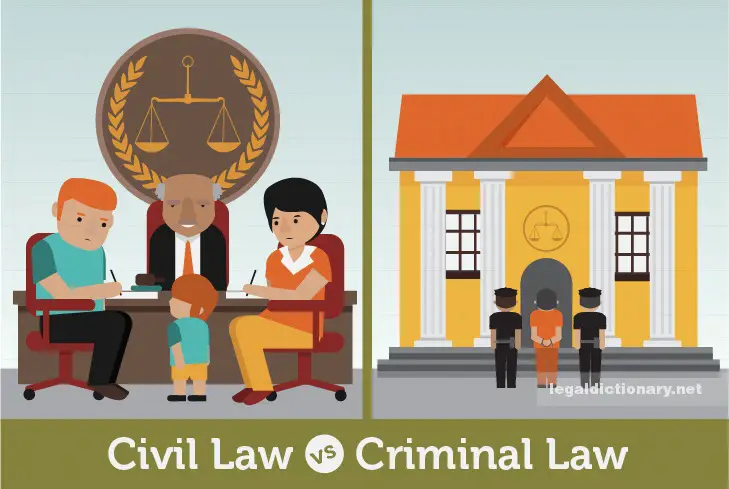
Civil law and criminal police force serve different purposes in the United States legal arrangement. The principal purpose of ceremonious law is to resolve disputes and provide compensation for someone injured by someone else's acts or behavior. The main purpose of criminal law is to prevent undesirable behavior and punish those who commit an act deemed undesirable past society.
In civil police force, it is the injured person who brings the lawsuit. By contrast, in criminal police force, it is the government that files charges. The injured person may file a complaint, merely it is the government that decides whether criminal charges should be filed. A violation of criminal law is considered a criminal offence confronting the state or federal regime and is a violation of public constabulary rather than individual constabulary. Civil law cases are concerned only with private law. In some instances, a person may be entitled to file a complaint, trusting the legal organization to punish the wrongdoer with prosecution, while bringing a ceremonious lawsuit to receive compensation for the damages done by the wrongdoer.
Some other central departure between civil and criminal law is the standards of proof required to reach a verdict. A plaintiff need only show his civil police example by a "preponderance of evidence." This standard requires that the plaintiff convince the court that, based on the testify presented at trial, it is "more likely than not" that the plaintiff'south allegation is true.
In contrast, the standard of proof is higher in criminal law proceedings. The state must testify their case "across a reasonable doubt." The reason for this higher standard is because a person's freedom is at stake, and the fundamental belief that convicting an innocent person is worse than allowing a guilty person to go free.
Branches of Civil Law
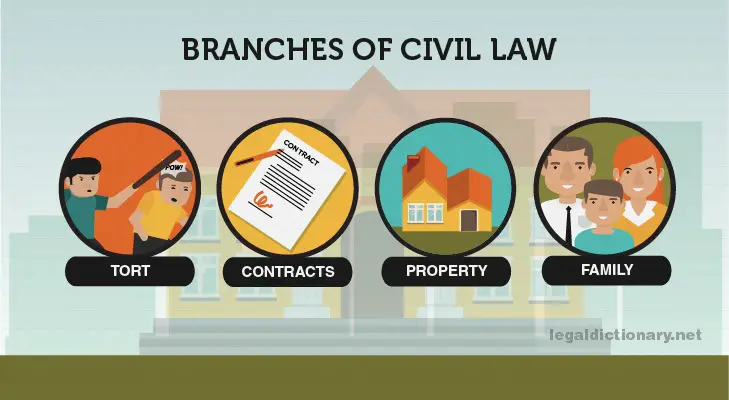
Ceremonious law cases are divided into four principal categories, each covering a range of issues. Meet beneath for the types of civil cases and respective ceremonious police examples.
Contract Law
Contract law deals with agreements between two or more parties, each of which is obligated to hold upwardly their portion of the understanding. For example, 2 parties enter into an understanding for the lease of an apartment. The Lessor has the right to employ the apartment, and the landlord receives hire money equally compensation. If one political party violates any of the provisions of the contract, they have committed a civil wrong known as "alienation of contract." Generally speaking, contracts may be oral or written, however in that location are sure types of contracts that must exist put in writing.
Tort Police
Tort law is a branch of civil law that is concerned with personal injury and ceremonious wrongdoing. A tort is a civil wrong, done by i person or entity to another which results in injury or property impairment, and oft involves monetary compensation to the injured party. There are three categories of torts: negligence, intentional tort, and strict liability.
Negligence is an unintentional tort, to which at that place are four elements that must be satisfied.
- Duty. The defendant had a duty to deed in a reasonable manner
- Alienation of Duty, pregnant that the accused failed to human activity reasonably
- Causation. The defendant'southward breach of duty must be the cause of the plaintiff's injury or loss
- Damages. Monetary, property, or other loss
An intentional tort is a deliberate wrongdoing in which the accused acted with intent to cause harm or injury. Some examples of intentional torts include: set on and battery, simulated imprisonment, fraud, invasion of privacy, and intentional infliction of emotional distress.
Strict liability is a tort that does non require actual negligence or intent to injure. It is based on an absolute or "strict" duty to ensure something is condom. Strict liability frequently comes into play with chancy activities, such as bungee jumping. The company that owns the bungee cords, or offers the action to consumers, has an absolute duty to make sure the bungee cords are intact, hooked up correctly, and are set up to operate safely. If a consumer is injured because the cord breaks or comes undone, the visitor is liable for the injury under strict liability.
Property Constabulary
Property law covers both personal belongings and existent holding. Personal holding tin can be tangible, such as jewelry, animals, and merchandise, or intangible such every bit patents, copyrights, stocks, and bonds. Real property refers to land and anything built on it that cannot be easily removed, also every bit annihilation nether the surface of the land, such every bit oil and minerals. At that place are 2 types of holding law torts: trespass and conversion.
- Trespass to chattels refers to a defendant intentionally and physically interfering with the plaintiff'due south right to possession and use of their personal property.
- Trespass to land occurs when a defendant enters plaintiff's private property without consent of the plaintiff.
- Conversion refers to a defendant depriving a plaintiff of their personal holding without the plaintiff's consent, and then using the plaintiff's belongings as his own.
For instance, a lady sees her neighbor planting flowers in her garden, and notices she has five actress containers of flowers with no place to constitute them. The lady decides she would similar flowers in her garden also, and takes the leftover containers of flowers without asking for permission from neighbor. The lady deprived the neighbor of her flowers, planting them instead in her own garden. The lady has committed conversion.
Family Law
Family law is the branch of civil law that deals with marriage, divorce, disparateness, child custody, adoption, birth, child support, and any other bug affecting families. This co-operative of civil law is unique in that there is non necessarily a person who committed a civil wrong. This is especially true in states that have no-mistake divorces. The family court gets involved with dividing up belongings and finances after a divorce, establishing child custody, child support, and spousal back up amidst other things. Some newer areas that autumn nether the family unit constabulary umbrella are same-sex spousal relationship, artificial conception, surrogate motherhood, in vitro fertilization, and palimony.
Civil Case Example
While the lawsuit confronting McDonald'south made national headlines, the facts of the instance regarding negligence, defective production, and breach of implied warranty make a fascinating civil case.
Liebeck v. McDonald'due south Restaurants CV-93-02419, 1995 (N.M. Dist., Aug. xviii, 1994)
This case began when 79-year-old Stella Liebeck, who was a passenger in her grandson's auto, purchased a cup of java at McDonald's drive-through. While the car was notwithstanding parked, Liebeck removed the lid from the cup to add some creamer to her java, inadvertently dropping the cup and spilling the scalding hot coffee on her lap. Liebeck suffered tertiary-degree, deep tissue burns on her legs that required multiple surgeries and skin grafts.
Liebeck filed a civil lawsuit against McDonald'due south for her injuries under the torts of strict liability and negligence. This case was controversial in that the media portrayed Liebeck'southward civil lawsuit as frivolous because she was suing over coffee being too hot. However, the damages to her torso, her pain and suffering, loss of income, and loss of enjoyment in life due to pain were existent and she did prevail in courtroom. The jury constitute that the defendant'southward production (the coffee) was defective (also hot to beverage) and this constituted a breach of implied warranty (the assumption that the java was safe to potable). The jury also found that Liebeck was twenty percent at fault for her injuries.
Related Terms
- Preponderance of Evidence – the standard of proof used in most civil trials; the jury is instructed to notice for the political party that has the stronger evidence, fifty-fifty if it is only marginally stronger than the other side.
- Beyond a Reasonable Dubiousness – the standard of proof used in criminal trials; a reasonable person would believe that the defendant is guilty of the criminal offence; a higher standard than is used in ceremonious law.
- Common Law – the body of law that is based on judicial decisions.
- Stare Decisis – the doctrine that requires judges to use prior cases every bit precedent on which to decide current cases.
- Instance Law – judge-made law; law that is found in collections of reported cases.
- Chattels – an detail of tangible, movable property; possessions that can be moved from 1 identify to some other.
- Lessor – a person who leases or rents out a holding; a landlord.
- Lessee – a person to whom a lease is granted; a tenant or renter.

Source: https://legaldictionary.net/civil-law/
Posted by: stopsalave1946.blogspot.com
0 Response to "What Conclusion Can You Draw About The Effects Of Civil Rights Legislation?"
Post a Comment