

What Is The Tape Thing Asian Use In Makeup
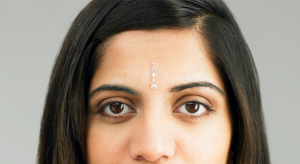
A forehead close-up of a person wearing a bindi. Source: iStock
Originally published on Wear Your Vocalisation Magazine and republished here with their permission.
Countries across Asia and across are mired in a history of oppression. For many of united states, the oppression is far from over, and we nevertheless exist inside marginalized communities.
Over the years, the racial microaggressions that offend and upset us have mutated, only they are aggressions still. Look at it this style: When you have been colonized, had your finery stolen, and your identity poked fun at, cultural appropriation is not just personal; information technology points to a bigger moving picture.
The 2013 affiche entrada "We're a Civilization, Non a Costume" past Ohio University highlighted how problematic it is to view someone else's culture as make believe.
As an Indian woman, I don't know where to get-go with the cribbing of Indian civilisation. I get information technology. Nosotros have opulence, grandeur, and a rich culture that evokes thoughts such every bit "mysticism" and "exoticism."
When I vesture the bindi, it makes me bourgeois and traditional, but if Vanessa Hudgens wears a bindi, it's "cool?"
To add farther insult to injury, ASOS decided that bindis were a Halloween accessory (thanks, ASOS, for putting the bindi in the same category as skeleton leggings). Thankfully the uproar from ASOS consumers made the visitor remove the choice on bindis.
Allow's become through a list ten of the most widely appropriated South Asian accessories and what they actually mean.
1. The Bindi – Surprise, Surprise!

Paradigm Credit: Writer (Aarti Olivia)

The Bindi, also known as the Pottu (a red vermillion dot) or a tilak (a vertical mark), is placed on the eye of the forehead between the eyebrows, which is known equally the third middle, referring to the point of college consciousness.
A black bindi is worn in parts of Southward Bharat by unmarried girls, while married women article of clothing a red bindi. Although not all Indian women follow these rules of color for bindis today, it holds a special significance. Men sport the tilak after a prayer or religious occasion. I have had the bindi placed upon my brow since infancy.
The band No Doubt made waves on the radio and MTV when I was a teenager, and bindis became the new absurd accompaniment thanks to Gwen Stefani. There is no doubt (no pun intended) in my mind that this pattern has probably been repeating itself for decades long before I was built-in since the West has always shown a keen involvement in South Asian wear and accessories.
While it looked absurd to my friends when they sported a bindi, I could not help but feel foreign about it, similar an invasion of space.
My peers had no clue as to what the significance of the bindi was and given that I used to become strange stares when I did wear them before No Doubt's popularity; I felt uneasy almost the immediate mass appeal for it.
Petty did I know, I would see history echo itself over and over (and over) again until information technology came to a indicate where it got annoying to come across withal another celebrity wearing bindi/south to music festivals.
When is it adequate to vesture a Bindi?
- If y'all are getting married to a Due south Asian
- If you attend an Indian festival/ritual and have a vermillion dot placed on you as a sign of welcoming 1's guest
ii. The Maang Tikka

Image Credit: Pabak Sarkar via Creative Commons

The new favorite Indian accessory we accept seen in plenty of in stores.
The center function of your hair is known as the Maang and is an of import feature for married or soon-to-be married Indian women. The Tikka is the ornately jeweled function of the accompaniment that is placed onto the forehead.
Information technology is styled differently, depending on what part of Bharat you lot hail from – the Rajasthanis wear a Maang Tikka, otherwise known every bit the Bor, that has a simple round tikka at the brow, while in a Muslim wedding, the Jhumar Tikka that is placed on the side of the head. There is a special significance for each variation. A bride-to-be typically wears an intricately embellished Maang Tikka.
When is it acceptable to wear a Maang Tikka?
- If y'all're getting married to a Southward Asian
- If you lot are part of a Due south Asian bride/groom's wedding entourage
3. The Nath (The Nose Ring)

Image Credit: Steve Evans via Creative Eatables

Indians wore rings on the nostril and septum mode before information technology got fashionable. Nose rings didn't originate in India; they were brought to the region by the Centre East, cheers to the Mughal Emperors.
Like the Bindi and Maang Tikka, they take variations that hold special significance. Brides wear a nose ring that extend with a concatenation, and some rural parts of India wear larger nose rings as a sign of marital condition or affluence. The women in my family unit have been wearing nose rings all their lives.
Which was why I was defiant in schoolhouse when I was told to remove my nose ring later on piercing my olfactory organ at fifteen. I did information technology to commemorate my very get-go trip to the homeland.
Naturally, I was sent to detention for disobedience, even though this is a marking of my culture. Today, when so many peers wear ane, it'due south not considered a problem.
I practice not take issue with the nose ring every bit much, simply I do not like the bridal nose ring existence exported as all the same another fun mode accessory. This style of olfactory organ ring is specifically for the South Asian bride.
When is it acceptable to wearable a Nath?
- When it is not a bridal olfactory organ band being worn as a fashion accompaniment (the other styles are just fine)
- If it is a function of your own civilization
4. The Paayal (Dancing Anklets)

Epitome Credit: Author (Aarti Olivia)

The foot is regarded in Hinduism as the humblest and most impure office of the body since it touches the footing first. Adorning a woman'southward anxiety symbolizes an act of devotion by her family or spouse.
Gold anklets are strictly forbidden in Hinduism because Gilt symbolizes Lakshmi, the Goddess of Wealth, and we do not place God at our feet.
Hindu babies are adorned with unproblematic silver anklets and typically, a girl child continues to wear anklets while boys abound out of it. Anklets are also viewed as a symbol of femininity, coquettishness, eroticism, and dance.
When I learned the South Indian dance grade known as Bharatanatyam, I wore thick anklets with bells known every bit the Saalangai, and when I picked up the Northern Indian dance form known as Kathak, I wore thicker anklets with bells known as the Ghungroo.
These hefty accessories are meant to accentuate the rhythm of trip the light fantastic toe and to appreciate the complex footwork for the forms of Indian trip the light fantastic toe.
Also, they are a very handy guide for dance teachers to figure out who is not dancing coherently to the rhythm. Not fun to get singled out in dance class, I can vouch for that!
During my fourth dimension of study for both dances, it was not uncommon for a non-Indian to take involvement in learning the trip the light fantastic toe forms. They proficient along with us and were respectful about it, while taking great intendance of the anklets (you lot are ordered to practise so) and learned to tie it accordingly.
It is a different story, however, when a tourist thinks it'southward fun to purchase these anklets and parade them with no knowledge of its use or history.
When is it adequate to wear a Paayal?
- If your culture wears them every bit an accompaniment like u.s.a.
- If you are an Indian dancer or a South Asian bride
5. Chudiyaan (Bangles)

Image Credit: Author (Aarti Olivia)

Indian women have been adorning their arms with bangles since ancient civilisation.
Depending on region and community, bangles are made out of differing materials – drinking glass, silver, conch, or trounce. A newlywed bride from parts of N India and Punjab, for instance, is expected to wear a total gear up of bangles known as the Chuda for the start two weeks of marriage.
While it has been traditionally expected that married women habiliment bangles, it is no longer imposed upon us. We practice, however, vesture them for religious or festive occasions. Like the paayal, infants are gifted with bangles.
In pop culture, you have probably seen the likes of Iggy Azalea and Selena Gomez wear them for music videos and performances.
When is information technology acceptable to habiliment Chudiyaan?
- If you are in attendance of a Hindu friend's matrimonial functions and the dress lawmaking is Indian ethnic – but be sure to check with your host offset
6. The Saree

Photograph Credit: Khadija Dawn Carryl via Creative Commons

Like the bangle, the saree and cloth weaving culture have been mentioned from the days of the Indus civilization.
It is still considered the primary piece of clothing in India even in modern wardrobes like mine and the tradition of draping one has been going potent for the past 6000 years. It is considered a symbol of Indian femininity and sensuality.
A saree is typically 6 yards long, and there are countless of textiles and draping methods that vary according to the region you hail from.
South Asian women across the world and from all walks of life clothing them at home, during an occasion, while in attendance of prayer, or at the workplace.
It is worn with a blouse the length of a ingather height and a petticoat used to help tuck in the pleats of the saree in social club to hold information technology in place.
I am not the all-time at draping a saree, merely I do capeesh the place information technology has in my life as an Indian woman. Since I am a Northward Indian married to a South Indian (our cultures could not be any more than different), it has been interesting to see the differences in which we pick out fabrics and styles. Information technology is a custom for the bride-to-be to be gifted sarees from her family, and I have an array of 25 sarees (I kid you lot not!) in my wardrobe.
The thing nigh wearing one is that the await is considered unfinished if you exercise not accessorize with at least bangles and a bindi. And even that is considered too unproblematic!
When is it adequate to wear a saree?
- If you are in attendance of an Indian part that stipulates Indian ethnic attire. It would be advisable to go a hand with how to wear 1 properly since information technology takes some effort.
- Please do non habiliment this for Halloween.
7. The Toe Ring

Image Credit: Flickr user indi.fetish via Creative Eatables

Also known as the Bichiya or Metti, it is often seen on the feet of married women.
The tradition of wearing a toe ring has dated back to the Ramayana – a Hindu epic poem – where Sita tosses her toe ring afterward getting abducted by Ravana in the hopes that information technology would help her husband Lord Rama during his rescue mission.
The ring is typically fabricated out of silvery and worn in pairs on the second toe of both feet. There is an open hook at the back to get in easy for removal when it is in need of a polish or if the feet require a thorough cleansing.
Similar the paayal, they are non made out of aureate for the same reason. They are placed by the groom onto the bride's feet during the Hindu wedding ceremony. I am unable to habiliment them due to nerve injuries on both feet, but I did take them on for the elapsing of my wedding ceremony.

When is it acceptable to article of clothing a Bichiya toe ring?
- If you lot are married to a South Asian.
8. The Aum Symbol

Image Credit: Flickr user Tengriana via Creative Eatables

Oh boy. Where do I brainstorm with this one?
The well-nigh sacred symbol in Hinduism. The essence of all mantras and divine scripture.
It is the representation of the holy Hindu trinity of Gods – Brahma, Vishnu, and Shiva.
It is the representation of three worlds – Earth, the Temper, and Heaven.
It is the representation of the 3 sacred Vedic scriptures – Rig, Yajur, and Sama. It is the audio of the conch at prayer.
This feels a lot more personal than the rest of the accessories mentioned. To even place it on this list feels incorrect, just information technology has been "accessorized" and thus needs to be addressed.
The Aum is used everywhere now – and not as it should be.
We keep this symbol shut to our being considering it centers us and beckons united states to perhaps utter a prayer (most Hindu prayers begin with the Aum). The reason this is uttered so often is because of the power it has to modify your pace of heart should you feel uneasy.
So when I see someone wearing it on their tie-dye camisole or sarong during a resort vacation, y'all tin imagine how information technology feels. But like in any other religion, nosotros keep some things closer to our center and spirit.
When is information technology acceptable to wear the Aum?
- If yous sport one as a pendant, bangle, bracelet, or a tattoo (be mindful of its placement) and are a practicing Hindu
9. Hindu God Images as Tattoos

Photo Credit: Flickr user Nick Gray via Creative Eatables
If you've read my commodity about the Australian who got into trouble for his Yellamma tattoo on his dogie, y'all are then well enlightened that tattoos are non taboo for us, but the placement and imagery play an important office.
For a Hindu, a tattoo of the Aum, Sanskrit scriptures, or an image of a God/Goddess serves as a sign of devotion or has a protective quality.
Some of our Gods – namely Ganesh, Shiva, and Kali – seem to exist cooler than the residue, and they have been tatted onto bodies across the world.
When is it acceptable to get a tattoo of a Hindu God?
- While I am deeply appreciative of tattoo culture, it would be advisable to become these tattoos only if they hold a deep significance to you
- Please mind where yous place them on your torso. The legs are considered the dirtiest part of ane'due south body, and getting 1 on your back is frowned upon.
10. The Mangalsutra, Besides Known as Thaali/Maangalyam (South Republic of india)

Photograph Credit: Flickr user Fatima via Artistic Commons
This is a sacred thread of love and goodwill worn by married women as a symbol of their marriage.
It is ane part out of the v signs of marital condition of an Indian woman. The residuum of the five take been mentioned in the article – toe rings, bangles, nose ring, and kumkum (vermillion powder worn at the Maan only before the forehead).
Historically, the tradition seems to have originated in the 5th-6th century A.D. Different regions and communities of India have varied versions of the mangalsutra or taali. Some wear information technology on a xanthous thread, others on a thick gilded chain, yet others have black chaplet strung together with two "vatis" representing the spousal relationship of two strung at the end.
Some accept diamond pendants while others accept coral beads. The blueprint actually depends upon the family unit traditions. And, often the taali is elaborately crafted with representations of the family deity — Shiva, goddess Sri, the tulsi (basil plant), or the emblems of Vishnu.
The black beads of a Mangalsutra denote the safety of the groom'south life from evil forces. It is considered compulsory in some parts of India to wearable the thread as a married woman due to its symbolism.
Even so, the appropriation of the Mangalsutra does not happen in Asia as much, merely the pretty blackness beaded necklace has captured the optics of many in the West.
11. Henna, Also Known as Mehendi

Photo Credit: Flickr user Josh Rodriguez via Creative Commons
While it is popularly known as decorative material, Henna paste was used in ancient civilization to provide comfort in diseases related to blood circulation and body aches, with a cooling de-stressing effect on nerves and muscles.
Some women still do brand their own paste with the leaves, but it is most unremarkably used today past applying it with a plastic or paper cone to create more intricate patterns on easily and feet.
The earliest evidence of henna application appears to have been mentioned in Arab republic of egypt and in the earliest Hindu Vedic ritual books. It is widely used in South Asian countries – Republic of india, Pakistan, Nepal, Bangladesh – every bit well every bit the Center Eastward and Africa.
Each of these regions utilize henna with a unique significance to their culture. In India, Mehendi is typically applied during festivals such as Diwali and during weddings.
For women, these designs are fatigued on the palm, back of the mitt, and on feet, to dissimilarity with the lighter skin on these surfaces, which naturally contain less of the pigment melanin. But times have changed, and we depict them on the forepart of our easily and legs to brandish the patterns henna artists work laboriously over.
Since there is a shortage of traditional mehendi artists, using plastic cones makes the application of henna easier and more accessible.
Henna "tattoos" have become simply as commonplace as bindis inside the Western culture.
The consequence here is not the use of the plant; it is the convenient fashioning that inadvertently erases the cultural significance of this ritual that is a bother.
Information technology seems to take fallen into the unfortunate pit that is "new age spiritual hipster living." It is worn like a crown of "individual artistic expression" and uniqueness, when the fact of the affair is, the designs that we have been placing on our hands and feet are a symbolic representation to awakening the inner lite, an ode to the sun.
As well, some of us don't have a pick in the matter. When brides are married off without their consent (yes, it still happens), Mehendi is an unfortunate sign of patriarchy – submission to the unwanted matrimony, a possession of the feminine trunk.
So while this is a fun option for the Westward, it is an imposition on some in the East. There is so much history steeped in this and it is unfortunate that this thing of beauty has been commodified into a sticker set.
So if you are not a person of color, I would circumspection you confronting wearing this for an "Indianized" look – I don't fifty-fifty know what that term is supposed to mean. It is offensive, but I take read it i too many times. Here's looking at you, Madonna.
***
While you may take experienced the ire of a South Asian SJW for wearing our accessories, it is imperative to recall that we have always been welcoming and accepting of tourists or foreigners who wish to learn more well-nigh our way of life.
What tires u.s., however, is the misinterpretation, misrepresentation, and disregard of South Asian culture.
While there are more individuals who take it upon themselves to become educated about these details, at that place still be the many who think information technology is exciting to apparel up like u.s.a. for the fun of information technology and water down or commercialize significant symbols. It is understandable that acculturation happens; a lot of us live in a merry being of a myriad of cultures.
Only be careful when threading the line betwixt showing appreciation and respect for a foreign culture versus picking and choosing elements of it for a laugh.
While non everything done is inspired by a culture to appropriate off it, you might want to go some research done before you attempt something on to make sure you don't come across every bit racially insensitive.
I practise not wear these accessories often due to the nature of my work life and personal reasons surrounding "female person obedience" – let's just say I do not work well with authorization!
But equally you have read, I value and understand their significance plenty to be able to inform yous that these are non of mere aesthetic value. The rituals and symbolism of S Asian culture are beautiful. But like how Dia de Los Muertos' saccharide skulls, catrinas, and ofrendas are part of a very important Mexican festival.
What you can do is support our art, culture, and music. And you lot tin telephone call out the appropriation of meaningful festivals or traditions when you see them happening, passing some of the knowledge you learned hither along to them.
Aarti Olivia Dubey is a first generation Southasian Singaporean. She is a plus size fashion blogger, body positive advocate, and feminist. She holds a Masters in Psychotherapy with a focus on contemplative psychotherapy and psychoanalysis. Being a socially awkward introvert, she prefers to put her thoughts into writing while observing the globe. She loves animals to a fault and is a happy fur-mommy to three dogs and two cats.
Source: https://everydayfeminism.com/2016/01/south-asian-accessories-mean/
Posted by: stopsalave1946.blogspot.com
0 Response to "What Is The Tape Thing Asian Use In Makeup"
Post a Comment